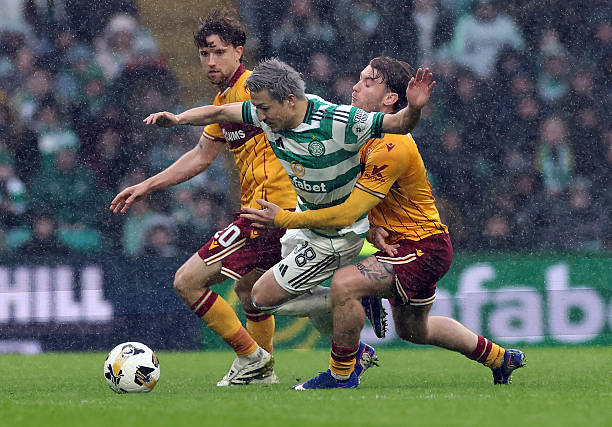
Celtic’s 3-1 victory over Motherwell at Celtic Park contained plenty of drama, but one moment in particular has continued to generate discussion long after the final whistle.
The game was level at 1-1 when a corner was delivered into the Motherwell box. Celtic forward Daizen Maeda and Motherwell defender Emmanuel Longelo became involved in a tussle as the ball arrived, and referee John Beaton initially waved away Celtic’s appeals, awarding a free kick to Motherwell. VAR official Kevin Clancy then intervened, advising Beaton to review the incident on the pitchside monitor.
What the cameras captured was subtle but significant. Replays showed Longelo maintaining his hold on Maeda fractionally longer than the typical contact seen in aerial duels, just enough to affect the Celtic forward’s ability to move freely and attack the ball. That detail, barely noticeable in real time, was precisely what the VAR review centred on.
BBC Sportsound’s Stephen Craigan outlined the key question facing the officials, noting that the holding needed to genuinely impact the player’s movement to warrant a penalty, and that the test was whether it had prevented Maeda from getting off the ground. Former Celtic goalkeeper Pat Bonner pointed to Longelo’s positioning, suggesting that once you allow an opponent to get inside you, you have to use your body and strength to manage the situation rather than resort to holding.
Beaton returned from the monitor and awarded the penalty, with Emmanuel Longelo also shown a red card. Substitute Tomas Cvancara converted to make it 2-1 and effectively swing the match in Celtic’s favour.
Motherwell manager Jens Berthel Askou accepted the call without protest, acknowledging that he had seen similar incidents result in a red card more often than a penalty. The footage of the incident has since become a focal point for debate, a reminder of how the finest margins, a fraction of a second of contact and a few inches of restricted movement, can determine the outcome of a match.