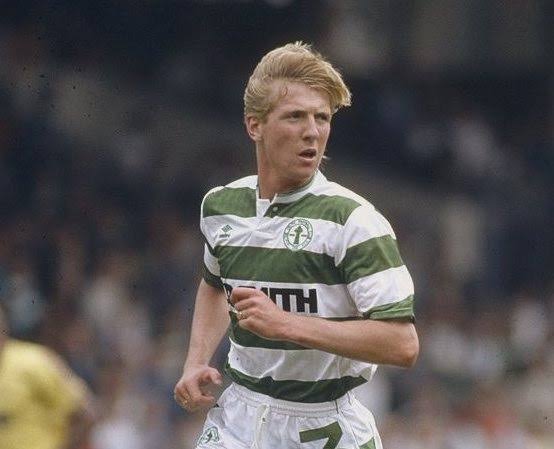
Anton Rogan remains a cherished figure in Celtic’s history, a cult hero forged during the club’s famous Centenary era who was heartbroken to leave the club he had supported all his life, sold off by a cost-cutting regime willing to accept Sunderland’s offer.
The full-back’s place in Celtic folklore was secured by moments that supporters still recall with great affection. He delivered the cross that allowed Frank McAvennie to equalise in the iconic Scottish Cup final against Dundee United, and scored in a memorable 3-0 victory over Rangers in 1991, perhaps the peak of his time in the hoops. Rogan was never the most technically gifted player, but his total commitment and physical presence made him a favourite with the Celtic Park crowd. Signed from Northern Irish club Distillery in 1986, he was a lifelong fan living out a dream.
That dream came to an abrupt end when Liam Brady succeeded the legendary Billy McNeill in the dugout in 1991. Brady, a Republic of Ireland and Arsenal icon, and Rogan never found any common ground, and it was the new manager who ended his time in Glasgow by agreeing to sell him to Sunderland for £400,000.
Rogan recalled the episode in an interview with the Irish News, making no attempt to conceal how painful it was. He had not wanted to leave, understood the club needed the money, but resented how it was handled. When Brady informed him of Sunderland’s interest, Rogan said he simply told him he would be on his way and walked off without even looking at him. He described being called into director Tom Grant’s office as he headed out, with Grant acknowledging the club did not want to lose him before confirming the inevitable. There were no warm words, no thank you, nothing. He walked out the door and never went back.
He was never entirely sure whether Brady simply did not rate him or whether the transfer fee made the decision straightforward regardless. Either way, the manner of his departure left a mark.
Rogan spent two years at Sunderland and, with the benefit of time and perspective, has come to appreciate what the move gave him. He grew up in Belfast and spent his career in Glasgow, two cities where being a Celtic player carried weight far beyond the football pitch. Living in Durham offered him something he had rarely experienced, the freedom to walk down the street without being recognised or subjected to abuse. It was, he admitted, a relief to step out of that particular goldfish bowl, even if leaving Celtic had broken his heart.