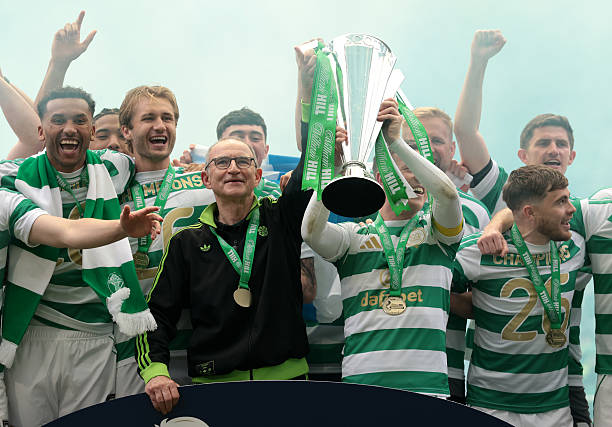
The O’Neill Effect: How Logic and Resilience Secured Celtic’s Title Triumph
The most complex situations are often simplified by the use of basic logic. At least, that is how it should work in theory.
Throughout the course of this season, Hearts have arguably possessed a better squad of players than Celtic. Heading into Saturday, they held all the cards. A mere draw or a victory against the home side would have seen them secure the league championship.
Instead, they achieved neither.
In football, analytical data is supposed to trump raw atmosphere. Big players delivering on the grandest occasions should carry more weight than a hostile crowd attempting to create an oppressive environment. Yet, logic was turned on its head at Celtic Park.
Under the guidance of Martin O’Neill, Celtic has operated as a footballing salvage unit this season, pulling results from the brink of disaster time and time again. This latest victory was just another entry into a remarkable logbook of recovery.
Rising Above the Noise
Looking at the fallout from Wednesday night’s match at Motherwell, you would have thought Celtic had unethically awarded themselves a penalty kick. The sheer volume of uproar surrounding John Beaton’s VAR-guided decision was staggering. An ill-mannered public reaction was quickly followed by ill-advised commentary, culminating in the shameful reality of a referee requiring police protection to return home.
Despite the external chaos, O’Neill’s squad maintained their composure. They rose above a controversy that was entirely outside of their own making, choosing to answer their critics with actions rather than words.
The match itself provided plenty of drama. Celtic suffered an early setback by falling behind to a Lawrence Shankland opener. They fought back, equalizing through an Arne Engels penalty, before unleashing their trademark dramatic finish. Daizen Maeda provided the crucial breakthrough, and Callum Osmand’s clinical late goal served as the perfect Hollywood ending to an epic sporting story.
The Unforgiving Truth of the Table
All of this brings us to an undeniable conclusion. As the old football adage goes, league tables do not lie. There are no asterisks, no footnotes, and no room for revisionist forensic analysis. The team that accumulates the most points assumes the mantle of champions.
Insinuations and protests mean very little. The only opinions suggesting otherwise belong to former professionals on television, and those are best left ignored. The reality boils down to simple accountancy, measured strictly in the columns of profit and loss. If you secure more points than the runner-up, the season belongs to you.
Naturally, perspectives on this triumph will differ depending on who you ask:
- The Romantics: Those driven by emotion will view Celtic’s title win as something pre-ordained, a spiritual certainty.
- The Cynics: Skeptics will counter that the dramatic climax reflects poorly on the overall quality of the Premiership, branding it a mediocre league filled with mediocre teams.
- The Statisticians: Football historians will point out that Celtic is the first team in 91 years to win the league despite losing eight matches, using that data to imply tactical inadequacy.
Ultimately, any attempts to diminish this achievement will be utterly drowned out by the roar of the Hoops faithful. The supporters recognize the sheer force of nature who orchestrated this astonishing moment in their club’s history: Martin O’Neill.
From Adversity to Adulation
Celtic’s season has been defined by self-inflicted adversity, sparked by questionable decision-making and boardroom incompetence. The initial, barely credible appointment of Wilfried Nancy was compounded by a string of transfer signings so poor they beggared belief.
Yet, rather than succumbing to the pressure, O’Neill embraced the chaos. His resilience has now earned its ultimate reward.
There will be an appropriate time to dissect the extensive list of structural issues at Celtic Park, but that post-mortem can wait. For now, Celtic earned the right to enjoy the afterglow of a triumph where sheer determination overcame despair. This turnaround was fashioned by a manager whose personal narrative reads like fiction but translates seamlessly into fact.
O’Neill succeeded in transforming a fractured team and a disillusioned fan base into a unified movement. It became an emotional alliance of hearts and minds dedicated to a single cause. The depth of this connection was perfectly illustrated just last week, when television cameras captured an elderly woman weeping tears of joy as Daizen Maeda scored with an overhead kick against Rangers.
The contrast to earlier in the year is stark. When Rangers triumphed at Celtic Park in January, furious supporters took to the streets to protest the club’s hierarchy. Nancy was swiftly dismissed, and O’Neill was brought back to unite a mutinous environment. It stands as an extraordinary testament to one man’s immense standing in the eyes of the supporters.
A Legacy Cemented
O’Neill’s definitive place in Celtic history can now be viewed in its proper context. At the absolute pinnacle stands Jock Stein, the immortal manager who delivered the European Cup and the historic Nine-in-a-Row. Right alongside that legacy sits O’Neill. While Brendan Rodgers won plenty of silverware, O’Neill captured the soul of the club at the exact same time he was winning leagues and cups.
There were critics who feared that the veteran manager risked tarnishing his flawless reputation by returning to the dugout at 73 years of age, especially after a six-year absence from the game. Next Saturday, in the Scottish Cup Final against Dunfermline, O’Neill has the chance to complete a domestic Double, rendering those initial anxieties entirely foolish.
In a twist of supreme footballing irony, it is Neil Lennon who stands between his former mentor and silverware, occupying the opposite dugout as manager of the Fife club. Should Celtic falter, it would mark their third consecutive cup final defeat under three different managers within a single year. That is an unwanted historical statistic O’Neill will be desperate to avoid.
Looking to the Future
The captain leading the team out will be Callum McGregor. Earlier in the season, McGregor looked like a man driven to absolute despair while trying to navigate the disastrous Nancy era. O’Neill has successfully dragged his captain, and several others, from the depths of sporting misery back to the absolute peak of their powers.
The long-term future of the captain, the interim manager, and a playing squad requiring a massive overhaul will dominate the summer headlines. Common sense suggests that O’Neill, who has effectively become the patriarch of the club, should remain involved in the upcoming rebuilding process. His ideal placement would be a modern boardroom role that honors his immense status rather than an active managerial position.
He was ultimately brought back to clean up a mess left by those in authority, individuals who should be incredibly grateful for his timely intervention. While Martin O’Neill may not represent the long-term coaching future of the club, he knows better than anyone else who is properly equipped to lead Celtic forward. In the meantime, he has managed the present absolute brilliantly.