






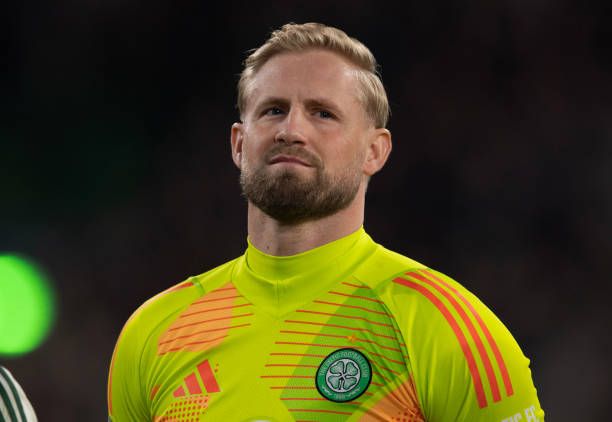
It is fair to say that a portion of the Celtic fanbase has grown increasingly frustrated with Kasper Schmeichel’s recent performances. Matters reached a low point when some supporters began booing the experienced goalkeeper with every touch during the closing stages of the defeat to Stuttgart. Schmeichel could reasonably have done better with at least two of the four goals conceded that night, and across the Europa League as a whole he has let in 5.06 more goals than the expected goals figures would suggest.
Despite that backlash, the Denmark international kept his place in goal for the Hibernian match in the Scottish Premiership. He conceded twice in another defeat, though on this occasion there was little he could have done to prevent either goal. His overall league figures still make for uncomfortable reading, with 3.15 more goals conceded than expected across the Premiership campaign.
Questions will naturally be asked about why Martin O’Neill has not moved to drop Schmeichel, particularly given that he has shipped just over eight more goals than expected when domestic and European football are combined. The statistics paint a picture of a goalkeeper who has let his side down at both levels.
The likely reason O’Neill has stuck with him is the alternative. Viljami Sinisalo has played only seven league matches above League Two level in England and was beaten twice from three shots in his sole Premiership outing this season against Livingston. The Finnish goalkeeper simply does not offer the leadership or experience that Schmeichel, for all his recent struggles, still brings to the position. That authority and composure may be precisely why the Premier League title winner retains the number one jersey.
A decline in Schmeichel’s output is disappointing but not entirely surprising given that he turns 40 later this year and is approaching the end of his career. Some regression at that stage is to be expected.
The same cannot be said for Daizen Maeda, whose drop in form this season is arguably more concerning than anything Schmeichel has produced. Last summer, the Japan international was keen to leave Celtic, as Brendan Rodgers more or less acknowledged publicly, but a proposed move to the Bundesliga fell through when the club could not source a replacement.
Maeda had been in extraordinary form. He claimed the Premiership Player of the Season award for the 2024/25 campaign after scoring 16 league goals, finishing the season with 33 goals and 12 assists across 51 appearances. This term, across all competitions, he has managed eight goals and eight assists in 39 appearances. The 16 goal contributions still represent a meaningful threat, but the contrast with last season is stark.
In the Premiership alone, Maeda has scored seven goals from an expected goals tally of 10.97 across 25 appearances, pointing to a player who has been wasteful with the opportunities presented to him. He has already missed more big chances in this campaign than he did throughout the entirety of last season, despite playing nine fewer matches. The quality at the top end of the pitch simply has not been there.
What makes this particularly hard to accept is the timing. At 28, Maeda is in what should be the peak years of his career, unlike Schmeichel who is winding down. After winning Player of the Year, the expectation was that he would either maintain that level or push on further. Instead, the opposite has happened. That gap between expectation and reality is precisely why his dip in form feels more alarming than the veteran goalkeeper’s.
The hope now is that Maeda can rediscover his best football over the coming months, play a decisive role in pushing Celtic toward the title, and then address the question of his future when the summer window arrives.